
Understanding entrepreneurial finance is not just about spreadsheets and valuation models. It involves judgement, incentives, and making difficult decisions under uncertainty. After transitioning into private equity, Anna Autti (MBA2026), discovered that the most valuable lessons came from analysing real-world dilemmas, the very challenges founders face every day. Drawing on her experience across M&A law, corporate strategy, and private equity investing, she explains how the executive course Financing the Entrepreneurial Business (FEB) sharpened her financial judgement, broadened her strategic outlook, and ultimately inspired her to return to LBS for a full-time MBA.

In 2018, I attended Financing the Entrepreneurial Business (FEB) executive course at London Business School. I enrolled to strengthen my financial toolkit as six months before I had transitioned into private equity. What I didn’t anticipate was how stimulating the experience would be, and how decisively it would influence my later decision to return to LBS for an MBA.
At the time, I had transitioned into private equity after several years working in M&A, first as a lawyer and then in a corporate setting. As a lawyer, I spent several years advising on a wide range of transactions, from small domestic acquisitions to complex cross-border deals involving multiple jurisdictions and stakeholder groups.
Whilst I was deeply embedded in the mechanics of transactions, the financial structuring itself was driven by other advisors. I understood the legal architecture of deals thoroughly, but I had not yet built the financial lens that ultimately determines how value is created. I moved in-house as an M&A Manager, where my focus shifted to actively reshaping a corporate business portfolio as my primary responsibility was the divestment of non-core business units. The objective was not financial engineering, but strategic clarity as the goal was to exit certain businesses as swiftly as possible to ensure attention was redeployed to areas with stronger long-term fit.
In addition to my legal studies, I had completed a master’s degree in economics, finance and management. So, it’s fair to say that I didn’t arrive at FEB looking to learn the mechanics of financial analysis from scratch, but rather at a moment of professional inflection.
High Intensity, High Engagement
FEB was one of the most intellectually demanding weeks I had experienced in a classroom – even after completing three university degrees! Although the pace was relentless, FEB rewarded engagement: the deeper you leaned in, the more transformative the experience became.
The real strength of the course was learning through the case studies. We analysed businesses from various industries, each facing different challenges: founder-led companies under shareholder tension, high-growth ventures struggling with operational scale, management teams navigating buy-outs, and entrepreneurs deciding whether to bootstrap or raise institutional capital.
These cases were never abstract. They tested frameworks against real-world situations. The insights travelled beyond the classroom. Whether in private equity, advisory, corporate strategy, or entrepreneurship, the core tensions around governance, growth, capital, and exit remained remarkably consistent. I applied these lessons repeatedly, even when the industries differed from those studied. In fact, none of the investments I worked on in my private equity role since FEB remotely touched upon the industries discussed during the week, yet there were many insights I could apply over and over again.
The questions we grappled with were not merely technical exercises, but fundamental strategic dilemmas. For instance, when does a founder bring in external capital to deepen management capability rather than simply to raise cash? How do you balance operational control with the need to professionalise a rapidly growing organisation? At what point does leverage enhance returns, and when does it begin to constrain strategic flexibility? And how should minority shareholder tensions be resolved when entrepreneurial vision and financial priorities diverge?
The cases reflected the real tensions that shape entrepreneurial businesses at critical inflection points, and they were demanding precisely because they forced us to think holistically. Financial modelling, capital structure, governance design, growth strategy and human incentives were intertwined. We had to take positions in each scenario and clearly justify our assumptions.
Lessons Applied in Real-World Investing
Whilst I may never found a high-growth consumer brand or face the exact circumstances of the companies we studied, I have found myself returning to the insights from those cases time and again in my work. When analysing new investment opportunities, I flook for dynamics that mirrored our cases, both in successes and failures.
Other key lessons I took with me were just how important management capabilities and aligned interest are, and that valuation discipline is non-negotiable. The realisation that valuation is more an art than a science was invaluable early in my investing career. It reinforced that whilst financial analysis is necessary, it is insufficient alone. Sound investment decisions emerge from a combination of quantitative rigour, commercial intuition, risk assessment and, above all else, structured debate. No matter what your opinion is, be prepared to validate it with sound facts: you are expected to justify your view, especially when equally qualified, or more qualified, peers arrive at different conclusions. Many can build a financial model, especially today with a little help from your favourite large language model, but fewer are comfortable confidently defending a valuation in the face of ambiguity.
The Power of Diversity
FEB surprised me with the diversity of perspectives in the lecture theatre. Participants came from various industries and geographies: investors, founders, operators, and executives from family businesses. Each brought unique experiences that shaped their assessments.
At first, it felt intimidating to share opinions among experts. But I soon realised that my experiences mattered. Differences in perspective became clear during discussions. People from diverse backgrounds broadened my thinking and challenged assumptions.
FEB also showed how cultural differences influence financing and operational decisions, reflecting how capital behaves in the real world.
Intellectual Momentum
Beyond cases, FEB was energising. The intense pace, advance preparation (which was not insignificant!), and quality of discussion created intellectual momentum. It reminded me how stimulating it is to step outside daily routines and immerse myself in rigorous learning.
Until FEB, I had not seriously considered returning to formal study. The programme introduced me to the LBS approach: practical, case-driven, globally informed, and grounded in real decision-making. This lit a fire in me: should I perhaps take a bigger leap and consider doing an MBA at LBS in the future? At around this time last year I answered that question in the affirmative; FEB, and in particular Professor John Mullins, had played a significant role. The programme offered a first taste of that environment and showed how structured learning can transform a few years into your career when combined with peers and faculty who challenge assumptions.
Relevance Across Career Paths
FEB proved more relevant than I expected. In private equity, it strengthened my ability to assess transactions with discipline and perspective. It also improved my understanding of entrepreneurs’ thinking, allowing me to communicate more effectively with them.
Financing decisions are inseparable from value creation; they shape long-term outcomes. In corporate settings, FEB deepened my appreciation for how capital structure influences strategic flexibility. Most importantly, it reinforced that financial judgement develops through practice, exposure, and debate.
For professionals considering FEB, it is worth being clear about what the programme is. It is a disciplined exploration of how real investment decisions are made under imperfect information, across diverse contexts and with meaningful consequences. It is for investors refining their judgement. For executives contemplating buy-outs or growth capital. For founders thinking more deeply about alignment and control. And for professionals who recognise that financial expertise evolves through dialogue as much as through modelling.
Lasting Lessons
When considering what kind of executive course I wanted to participate in, a key criterion was the immediate applicability of the learnings in my professional life. FEB delivered that. I left with sharper tools and clearer frameworks, directly applicable in my investing role.. But its longer-term impact has been subtler and perhaps more significant. It broadened my perspective on capital and strengthened my tolerance for ambiguity.
Nearly eight years on, the questions remain: What is something worth? How should it be financed? How do we align incentives for sustainable value creation? These questions sit at the heart of entrepreneurial finance and are, if anything, even more relevant today.
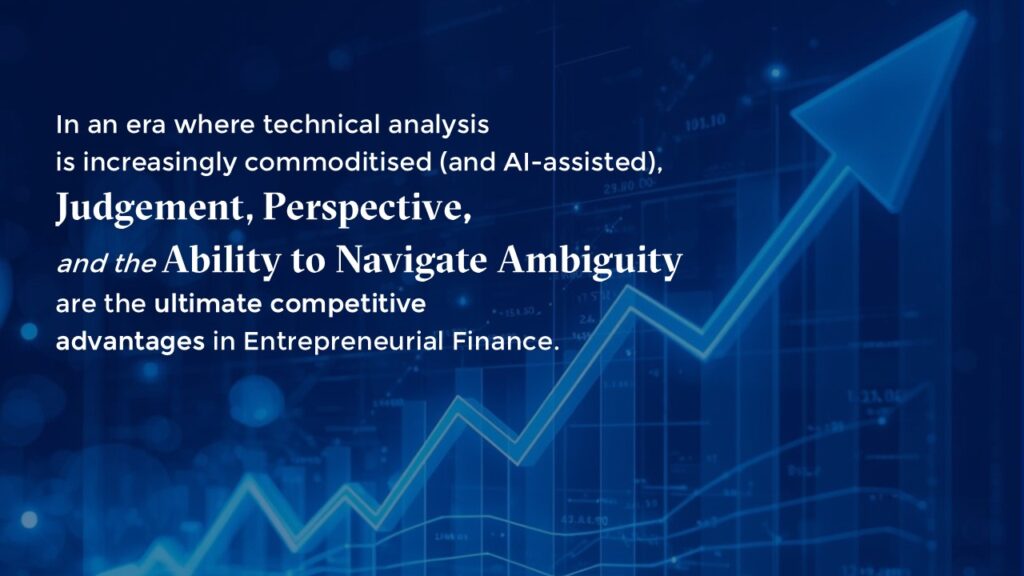
FEB taught me that while financial analysis and modelling are essential, they are rarely decisive on their own. As analytical tools become more widely accessible through AI, the real differentiator is judgement: the ability to interpret imperfect information, weigh competing priorities, and defend a point of view in the face of uncertainty. Judgement develops through experience, exposure to real dilemmas, and rigorous debate with diverse peers.
Looking back, FEB did more than sharpen my technical skills. It broadened my perspective on capital, strengthened my ability to navigate ambiguity, and reinforced the idea that sound financing decisions are inseparable from long-term value creation. These lessons continue to guide how I evaluate opportunities today and they remain a lasting competitive advantage in entrepreneurial finance.
About the author:
Anna Autti is a One-year MBA candidate at London Business School. Prior to the MBA, she was an Investment Director at CapMan Growth Equity, working with growth-stage companies across Europe. Earlier in her career, she worked in M&A and began as a lawyer advising on cross-border transactions. She holds degrees in law and economics and is interested in entrepreneurial finance and value creation in growing businesses.
Explore Financing the Entrepreneurial Business through London Business School Executive Education and discover how one transformative week can elevate your perspective for years to come. Next course to start on 13-17 April.
Find out more here.