
When women start companies, they earn far more than they would have in a salaried job. New research reveals that women who leave salaried jobs to start companies see a 22% earnings boost—far higher than men’s 8% gain. By bypassing biased workplace structures, entrepreneurship allows high-ability women to capture the value their skills deserve, narrowing the gender pay gap and reshaping career trajectories.
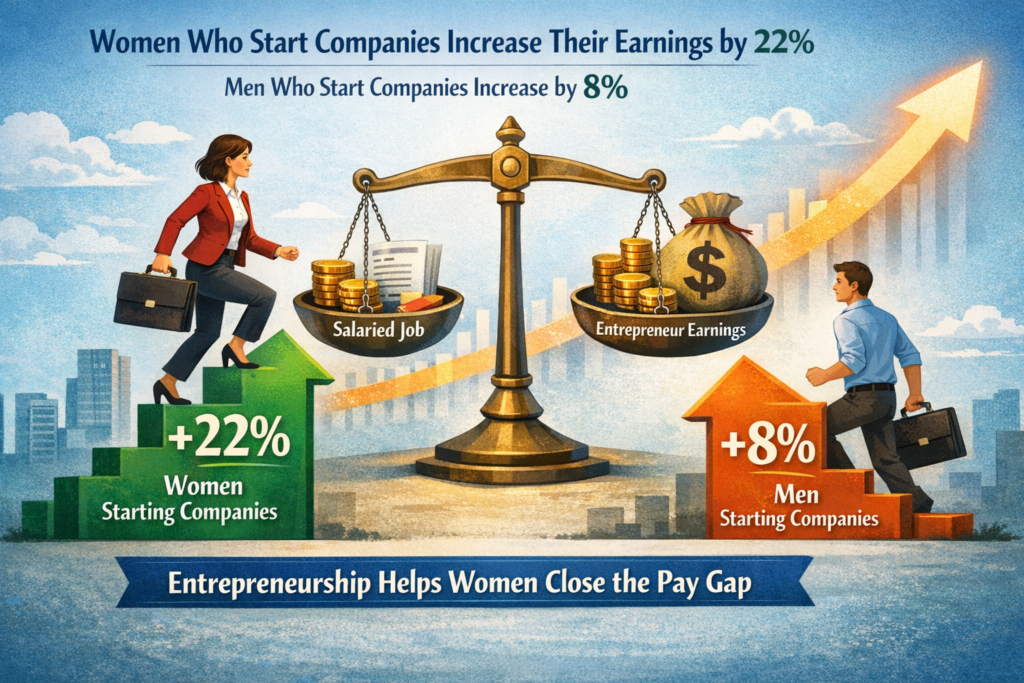
Here is a statistic that tends to stop people mid-conversation: women who leave salaried jobs to found companies increase their earnings by around 22%. Men who make the same move see a gain of about 8%.
That is not a typo. Nor is it because women are suddenly out-earning men as founders; they are not. Women founders still earn around 21% less than male founders in absolute terms. But when you ask the right question, not how women compare to men, but how women compare to what they would have earned had they stayed put, a completely different picture emerges.
Entrepreneurship, it turns out, is one of the most effective tools available to women for closing the gap between what they are worth and what they are actually paid.
The wrong comparison
For years, research on women and entrepreneurship has focused on underperformance. Women founders raise less capital. They run smaller companies. They earn less than men. All true. But this framing contains a category error: it measures women against men rather than against their own counterfactual.
Our new study, “Does Entrepreneurship Narrow the Gender Earnings Gap?” by Tiantian Yang, Aleksandra (Olenka) Kacperczyk and Lucia Naldi, corrects this. Rather than asking whether women do worse than men in entrepreneurship, we ask whether women do better in entrepreneurship than they would have done remaining in salaried employment, and whether that answer differs by gender.
To find out, we drew on matched employee-employer data covering the entire working population of Sweden from 1990 to 2020, more than 136 million individual-year observations. We tracked individuals over time, comparing earnings before and after founding a company, and used 12th-grade GPA as a rare and clean proxy for underlying ability. The results should prompt a rethink of how careers, organisations and gender equality are understood.
Narrowing the gap
The gender earnings gap in salaried work is, in the data, around 24%. In entrepreneurship it falls to 19%. That is nearly a 30% reduction, attributable to the act of founding alone.
The mechanism is not mysterious. Wages in employment are determined by managers, promotion committees and HR processes that are, consciously or not, shaped by gender bias. Women’s pay falls below what their qualifications and ability would predict. Entrepreneurship removes that layer of intermediation. As a founder, the market does the valuing: customers, clients and revenue, rather than gatekeepers. Capital markets carry their own biases, but the cumulative toll of employer discrimination across a career is substantially reduced.
The 9 percentage point difference in returns between women and men who transition to entrepreneurship is, the researchers note, equivalent in magnitude to four additional years of labour market experience. That is not measurement noise. That is a career.
The talent that leaves
The entrepreneurial premium is not evenly distributed, and where it concentrates is instructive.
We find that it is largest for high-ability women. In salaried work, the study finds, each additional grade point raises men’s earnings more than women’s. In entrepreneurship the pattern reverses. Returns to ability are higher for women. Organisations suppress what talented women are worth; founding a company restores it.
High-ability women appear to have worked this out. They transition into entrepreneurship at higher rates than equivalently able men, not because they are temperamentally more entrepreneurial, but because they have correctly assessed that their prospects in traditional employment are poor. For the most capable women, the glass ceiling is not merely a cultural grievance. It is a financial calculation.
The premium is also largest in male-dominated industries. In those sectors the gender earnings gap in wage work sits at around 37%. In entrepreneurship in the same industries, it falls to 27%. No equivalent narrowing occurs in female-typed sectors, where the structural barriers are already lower. The more hostile an industry is to women in salaried roles, the more entrepreneurship pays off.
Ruling out the alternatives
The obvious objections do not survive scrutiny.
Women are not earning more as founders because they are working longer hours. Entrepreneurship shifts men into full-time work at a higher rate than women. The premium is not an artefact of risk aversion selecting only the most confident women into founding. Women’s ventures survive and scale less well than men’s, not more. It is unlikely to be explained by the autonomy and flexibility that come with running one’s own business, since men and women gain comparable schedule control on founding, leaving no gender-specific mechanism to account for. And the premium persists among women without children, which rules out the motherhood penalty as its primary source.
What survives every robustness check is the following conclusion: talented women are systematically undercompensated inside organisations, and starting a business is how they recover what employment withheld.
Implications
For women weighing the decision to found, the financial case is stronger than the prevailing narrative suggests, particularly for high-ability women in male-dominated fields who have watched less capable colleagues advance past them. The data suggest the intuition of being undervalued is well-founded, and that founding offers a credible route to correction.
For investors and fellow founders, the pipeline of high-ability female founders is being supplied, in part, by organisations that fail to pay talented women what they are worth. That is not a demographic tailwind to exploit. It is a market failure that talent is navigating around.
For the companies losing these women, the question is not what made entrepreneurship attractive. It is what made employment insufficiently rewarding. A woman who founds a company is, in many cases, a signal that your organisation mispriced her.
For policymakers focused on closing the gender gap in venture funding, on improving access to networks, on tackling bias in investment, all of that matters. But the most consequential inequalities are occurring upstream, in wage employment, before anyone has written a pitch deck. Narrowing the gender pay gap in salaried work would do more for gender equality in the startup economy than almost any intervention directed at founders.
The glass ceiling does not only obstruct. For women with the means and appetite to leave, it also redirects. The startup world is fond of stories about founders escaping bureaucratic inertia to build something new. For women, that story carries an additional charge. Escaping a labour market that was never going to compensate them at the rate their ability warranted.
Aleksandra Kacperczyk, based on “Does Entrepreneurship Narrow the Gender Earnings Gap?” published in the Strategic Management Journal.
About the author: Aleksandra (Olenka) Kacperczyk is a Professor of Strategy and Entrepreneurship at London Business School. Her research examines entrepreneurship, innovation and labour markets, with a particular focus on how individuals transition into founding new ventures. Her work has been published in leading academic journals and widely cited in research on entrepreneurship and gender