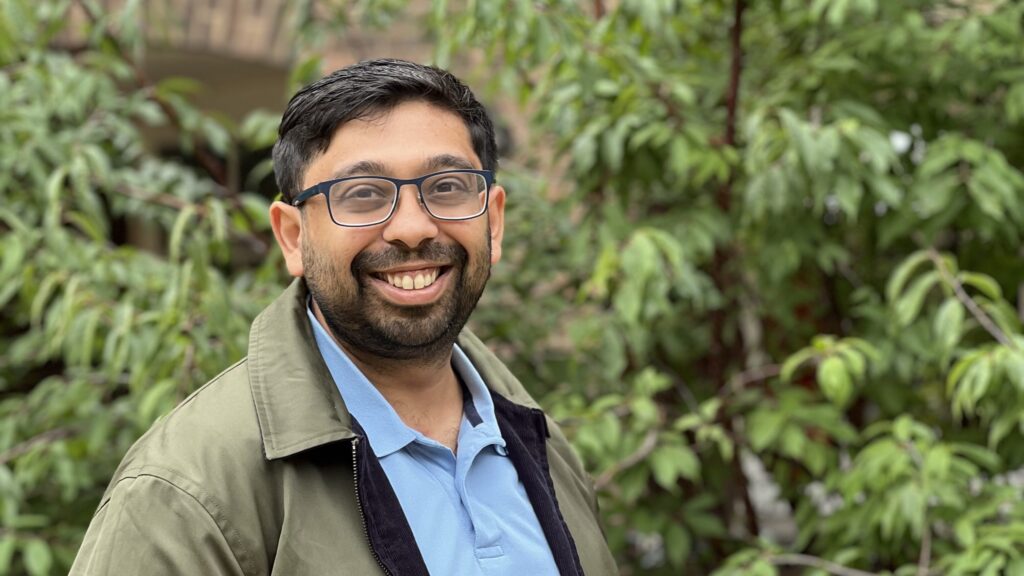
Viktoriia Moroz talked with Abhishek Kumar, founder and CEO of Evida, a UK-based clinician-led prevention and longevity platform with the vision of adding a billion healthy years to the lives of a hundred million people.
V: Abhishek, thanks for taking the time to speak with us. Can you tell us about the vision behind Evida and the problem you set out to solve?
A: Sure, the vision behind Evida is a society where everyone doesn’t just reach old age, but thrives in it, and the path to that starts in our twenties, thirties and forties. Healthcare’s done a great job of extending our lifespan, and now it’s about making every one of those years count. Unfortunately, the data suggests that the gap between lifespan and healthspan is growing with people on average starting to experience some illness by their mid-forties. That’s why by launching Evida we’ve set the audacious goal of adding one billion healthy years to the lives of a hundred million people. I’m pleased to share that in 2026 we’ve started seeing our first patients, getting great feedback and generating revenue.
V: That is quite an ambitious and noble goal! Can you walk us through Evida’s origin story?
A: Of course! While I graduated from the LBS MBA in 2025 and founded Evida at the end of July 2025, my motivation goes back a lot further. I grew up in a family of doctors, where healthcare has always been a passion. While my parents envisioned me as a successful doctor, I was more drawn to the business side of things. My career has spanned private equity – investing in healthcare and tech-, and consulting. Yet, I’ve always wanted to be an entrepreneur and joined the MBA with that ambition. Alongside extensive research and testing of different ideas, the crystallising moment for Evida’s creation came in June of last year when I went through a health check myself. The diagnostics were decent, but the medical history capture was poor, no wearables were involved, and I didn’t receive a follow-up for a whole year afterward. People around me seemed to be having the same problem. That gap between a good diagnostic and the lack of support behind it was the founding insight. Today, it’s up to the individual to get the right data, figure out the insights, and take action – and that’s genuinely hard, because there’s so much noise out there in the media about testing and wellness – it’s confusing to navigate as a consumer, even more so now with AI throwing conflicting advice into the mix. So I realised: why don’t we integrate all of that and make it easy to be healthy?
V: Makes sense, I have come across similar situations in my life as well, and a fast resolution would be of a large benefit! Also, I really like the slogan “Track, Tailor, Act” on your website. Could you explain how this model actually works for a member?
A: Good question, we actually put a lot of thought into this. It maps to the data, insights, and action I just spoke about. The start of the journey for our members involves onboarding their medical history and wearable data, as well as completing blood tests at one of our nationwide partner clinics – that’s “Track.” That data is then fed into a 45-minute GP consultation, where the same doctor reviews the health check and sets lifestyle actions with the patient – that’s “Tailor”. “Act” is the most important part and it is related to the structured follow-up at three, six, and nine months with that same GP, providing continuity of care. We have plans to achieve this with an AI-powered app, community, additional services and a partner network, all designed to take the friction out of being healthy, and all included in the membership.
V: How much does the membership cost, and what’s included?
A: The membership is £320 a year, with a discount for our pilot members. This includes the annual blood test with 40+ biomarkers, the 45-minute GP consult, three follow-up touchpoints with the same doctor for continuity of care, roughly two hours of GP time in total, and ongoing support from our health partner team.
V: Healthcare data is sensitive by definition. How do you handle security?
A: This is very important to us. Externally, our virtual GP consults run on an established, secure platform. Internally, we have an in-house CTO and a tech team responsible for end-to-end encryption and jurisdiction-appropriate data storage. Beyond the technology itself, we’ve built processes that ensure any access to patient data is strictly for the patient’s benefit. It’s important to get both the technology and the operational processes right for data security.
V: Regulatory approval is usually the hardest part of launching a healthcare company. What was that like for Evida?
A: It was the single biggest bottleneck to launch, and rightly so. The Care Quality Commission (CQC) is our primary regulator; approval took eight months and came through at the end of July. That meant roughly two to three hundred pages of submitted documentation and a four-hour-plus regulatory interview. It’s a demanding process, but getting the foundations right makes everything downstream easier.
V: Beyond regulation, what’s been the hardest internal problem to solve?
A: I’d say it was bringing the technology team together. Not the people themselves, but the processes around it. We had the right people on the tech side from early on, but our workflow, from a Figma design through to production, was clunky. Once we fixed the process, roughly around May/June, the same team suddenly moved much faster.
V: Evida has recently gone out of stealth mode and launched publicly, what led to that decision?
A: We came out of stealth after placing second out of 80+ teams at the LBS Health Tech Challenge, since that was an achievement worth sharing publicly. Building quietly gave us room to pivot without a public audience watching every change; the membership model today looks nothing like it did eight months ago, and it’ll likely evolve again. Launching publicly was also well-timed, coinciding with the launch of our Instagram and Substack accounts.
V: How has the product itself changed since the original idea?
A: Early on, we leaned heavily into fast, reactive GP access and even ran three separate membership tiers. Doctor and market feedback made it clear that those tiers weren’t producing meaningfully different outcomes for members. We still offer on-demand virtual GP appointments, but the real differentiator, based on direct user research, is the structured prevention model, not the speed of access. That insight drove the consolidation into a single membership.
V: Who do you look to as reference points in healthcare, and what differentiates Evida from them?
A: We track all of the big companies and publish a weekly news roundup on LinkedIn on Fridays. A big comparison point for us is Babylon’s UK trajectory. They had a huge early traction growing to a multi-billion valuation, but then effectively went bankrupt, which shows both the size of the opportunity and the execution risk in this space, along with other learnings. On the clinical AI side, we look up to and partner with Tandem, a Class IIa medical device already used widely across the NHS for AI scribing. Partnering with a leading provider like Tandem rather than building that capability ourselves makes our product more efficient. Evida’s differentiation is the clinician-led, continuity-of-care model built around a real GP relationship, not just a faster booking system.
V: Where does AI fit into Evida’s product, and how do you manage the risk of errors in a clinical setting?
A: On the non-clinical side, we use AI tools like Claude in our own development process, and we’ll bring AI into member-facing nudges over time. On the clinical side, we operate under the “AI in the loop,” instead of the “human in the loop” framework: doctors stay front and centre, with AI available as a second opinion when a colleague isn’t reachable, never as the primary decision-maker. With current regulations, our immediate focus is using AI scribing with Tandem, but given their Class IIa approval, we are keen to explore more clinical use cases, and will do so cautiously.
V: How do you recruit and contract your doctors?
A: GPs are employed directly by Evida, either on employment or contractor terms, rather than outsourced through a large GP practice. That’s deliberate. What we offer isn’t a standard GP consult, it’s health-check interpretation plus lifestyle medicine – so we recruit doctors with genuine training in that space. For example, our clinical lead is a GP and lifestyle medicine expert with NHS and private sector experience.
V: What’s been your focus for the last year?
A: Getting up and running. There’s been a lot of work behind the scenes that went into seeing our first patient. Apart from regulatory approval, we’ve partnered with six different providers to ensure a smooth experience: from bringing in wearable data, to nationwide blood testing, to prescription delivery. We also started marketing and have a waiting list of patients that’s growing each day. I definitely underestimated the complexity going into Evida, but it’s fantastic to see how it all comes together in a smooth customer experience. Internally, we use around eight different tools and subscriptions, and over the past year I’ve built out a fantastic team across clinical, commercial and technology that you can see on our website. That wouldn’t have been possible without the LBS Startup Incubator programme – the community, the office space, mentors and introductions I got through the incubator directly shaped who’s on the team today. It gave us credibility at the beginning and opened doors that would have taken a lot longer to open on our own. I’d highly recommend the incubator to any LBS alumni.
V: What’s next on the roadmap, and how does international expansion factor in?
A: Near-term, our focus is on the “Act” pillar: community features and AI-supported nudges, plus progress toward an integrated health record that merges private data with NHS records. Every country has its own healthcare regulatory regime, even Scotland and Wales differ from England, so international expansion will happen market by market; right now we are UK-focused. For us, Function Health’s traction in the US is an early signal of global demand and the scale of the opportunity.
V: You climbed Kilimanjaro during your MBA. Did that experience shape your approach to building Evida?
A: Yes, and even more than I initially expected. Thirty of us went up from LBS, four days up, two days down, and 100% of the group summited, which is genuinely rare on Kilimanjaro. What was important was spending a week with no screens and no signal. That left me with a clearer head than I’d had in months, and that lifestyle-reset value is part of what motivates Evida itself. On the founder’s side, there’s a direct analogy: on day one, the summit looks impossible if you look at the whole climb at once. You get there by focusing only on the next step in front of you and repeating that, surrounded by the right people, until you’re at the top. That’s been a great template for building the company.
V: Any closing advice for founders building in healthcare?
A: The only advice that really matters is the classic “just start.” But if I had to share the one thing I didn’t learn from an MBA or private equity, it’s this: founders get too attached to their solution, instead of the problem. That’s the trap I fell into myself, and I see it constantly in others. The first step isn’t building, it’s truly understanding why the problem exists. Without this, market research can turn into pitching your own product rather than testing it. The discipline that matters is staying anchored to the actual problem, and being willing to keep changing the solution until people are willing to pay for it.