
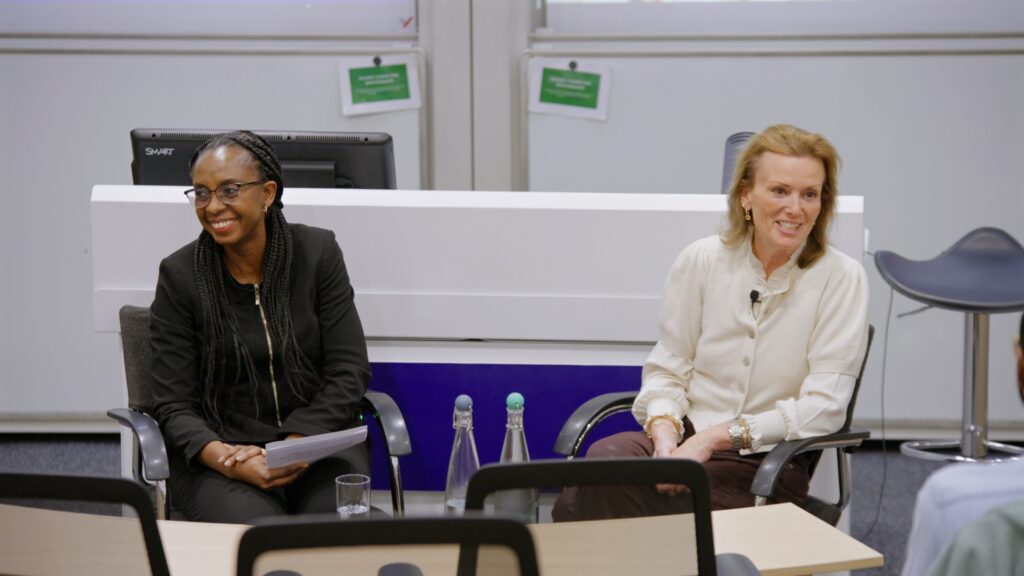
Last week I hosted a conversation with Joanna Jensen, founder of Childs Farm. Joanna’s story is well-known in consumer brand circles. She turned a personal need (gentler skincare for her daughter’s severe eczema) into a category-leading brand and exited with a £40 million deal. What made this session valuable, however, was getting to see how she actually thinks: practical, evidence-led, and refreshingly unsentimental about what makes a business investable.
From doing the maths to knowing when to let go, this conversation reveals the discipline and relationship-building behind one of the UK’s most successful consumer brand exits.
Below is a summary of our discussion, with strategic takeaways for founders.
Joanna, what’s the origin story – without the mythology?
My starting point wasn’t a trend report or a brainstorm session. It was my daughter’s severe atopic eczema, and the shock of walking into stores and seeing products that looked unchanged since the 1970s.
The market signal was strong. If a problem is widespread, persistent, and poorly served, there’s probably a venture-shaped opportunity hiding in plain sight.
But here’s where most founders would have stopped: “I believe there’s a market.” I didn’t.
I came from an investment banking background. I understood numbers. I understood commerciality. And I knew that no matter how passionate you are, if you don’t do the maths, you don’t have a business.
I started with NHS statistics (easily accessible): one in five children under five have atopic eczema. That’s half a million kids per age group in the UK alone. Multiply that across age ranges, add international markets where English is spoken, and suddenly you’re looking at a real customer base, not a hopeful guess.
Strategic takeaway: The days of building a business on gut feeling alone are over. But “doing the maths” doesn’t mean complex financial modeling. It means being honest about whether the numbers actually work, and being able to defend them.
How did you validate demand before raising money?
My validation process ran on two parallel tracks: data and experimentation.
On the data side, I used publicly available sources: NHS stats, consumer research from the British Library’s Business & IP Centre, YouGov surveys. I also emphasized something investors quietly reward: write down your sources. Not “a report said…” but exactly where your numbers came from.
On the experimentation side, I manufactured a small batch (funded with £5,000 of my own money) and distributed products to real users, starting with my daughter’s reception class, then expanding through my personal network to families with eczema-prone children.
The combined effect was powerful: numbers that made sense and early evidence that the product genuinely worked.
One parent called me in tears: “You have no idea—my daughter just had her first bubble bath ever. We’ve been using your moisturizer for a week and all her eczema is gone.”
I knew I had something. But I also knew anecdotes weren’t enough. So, when a Waitrose buyer told me I needed clinical trials, and the quote came back at £40,000, I hit what I call the “go or no-go moment”, the decision point where you either back the idea or walk away.
I backed it.
You talk a lot about “doing the maths.” What does that actually look like?
My version of “maths” isn’t a fancy spreadsheet. It’s a mindset:
Be honest about pricing and unit economics.
Be conservative in your assumptions.
Build a plan that can survive scrutiny.
Expect investors to challenge it and be ready.
One point deserves to be printed and taped to every pitch deck:
If an investor asks where your numbers came from, you should be able to answer immediately, or go away and come back within 24 hours. If you’ve got someone who’s actually shown up to a meeting about potentially investing, that’s a hot lead. You super-glue them to the floor.
I also warn against what I call “mortifyingly embarrassing” presentations where founders clearly haven’t done the work. Investors can spot flawed numbers instantly. And there’s no excuse! The data is out there if you’re willing to look for it.
Product decisions: why not go fully organic from the start?
This is where my strategic thinking came into play.
I worked with a manufacturer who understood natural and organic formulations, but I chose not to go fully organic early on, not because I didn’t value it, but because it would have pushed the price beyond what my target consumer could afford.
My anchor was concrete: “How much am I prepared to pay? No more than £4.”
That price ceiling shaped everything—ingredient choices, formulation, margin structure. I positioned performance as the marketing engine.
I didn’t have the power of celebrity to sell my products. My products had to sing for their supper.
I also made sure every ingredient had a story. The coconut oil came from a cooperative in the Philippines, not a conglomerate. So, farmers were growing organic coconuts and processing them into coconut oil. It was about creating a legacy that children using the products could feel good about, almost by osmosis.
Packaging in a “clinical” category: why go bright and playful?
I saw an industry norm: children’s eczema products often look like pharmacy labels: muted colors, clinical cues, a subtle signal that something is “wrong.”
Childs Farm chose the opposite: rainbow colors, playful cartoon illustrations of my kids and their pets done in photo decoupage which is cut out of bits of wrapping paper and candy wrappers with tiny nail scissors.
The logic wasn’t “be different for the sake of it.” It was empathy-driven design: children with sensitive skin don’t want a neon sign above their heads saying “I’ve got poorly skin.” They just want to feel normal.
And crucially, I tested it. Parents loved the packaging. Kids loved it. One industry veteran told me it would never work because the category was “boring, bland, beige, and white.” I knew he was wrong because I’d already validated it with real users.
Strategic takeaway: Don’t enter a saturated market by being louder. Enter through a niche you understand better than anyone else (for Joanna: children 1-5 with eczema), make sure the product genuinely works, protect your IP early, and then outwork the category on relationships.
Speaking of relationships, how did you actually get into Tesco, Boots, Waitrose?
My answer has nothing to do with “growth hacks.” It was relationship-building with a level of intentionality most founders don’t have the patience for.
I hand-delivered products to every major retailer—driving to Leeds, Bradford, Nottingham, you name it. And I got to know the receptionists.
I would drop off products, plus a bit of stuff for the receptionist and some nice chocolates. That’s how I got the names of buyers. Then when I came for meetings, the receptionist at Boots—Bridget—would say ‘Hi Joanna!’ She sold more Childs Farm than anyone else. People would come into reception, and she’d say, ‘Oh, I hear you just had a child, you need to go buy Childs Farm.’
Bridget gave a bottle of Childs Farm moisturizer to a neighbor whose daughter had chronic eczema. The neighbor tried it, saw results in two weeks, and posted before-and-after photos on Facebook. The post went viral—65,000 shares—and that was a game-changer.
All because of Bridget, the receptionist.
My broader point: ecosystems sell products, not just founders. Show up. Be kind. Be memorable. Know names. Treat suppliers like an extension of your team.
When Childs Farm went viral and sold 1.5 million bottles of baby moisturizer in a week, I could call my suppliers and say, “Sit down. I’ve got to tell you something. How many shifts can you add?” And they were excited because I’d spent years building those relationships, visiting warehouses every Christmas with gifts for workers, making YouTube videos to help with packing, leaving my phone number in case anyone had questions.
Strategic takeaway: Distribution isn’t just logistics. It’s human. Build relationships, invest time, go face-to-face. But when it comes to hiring, don’t hesitate to let go of poor fits. Knowing how to build relationships and when to end them is critical.
What do you look for now, as an investor?
I’m candid about this: at early-stage, you can’t fully “prove” the business. So, the founder becomes part of the product.
My rule of thumb: fifty percent of my decision-making is on the founder. I want to see the whites of your eyes. I want to know that you’re determined, resilient, robust, that you’ve done the preparation.
I frame the pitch meeting as a behavioral signal:
How you handle tough questions in that room is how you’ll handle customers.
How prepared you are is how prepared you’ll be in the market.
How quickly you follow up tells me whether you can execute.
Early-stage investing is as much about the person as the product, maybe more.
I’ve invested in brands that weren’t performing as expected because I was so impressed by the founder. And I’ve passed on good ideas because the founder didn’t show up right.
Team-building as a solo founder: what did you get right (and wrong)?
I built Childs Farm solo, and I won’t romanticize it. It was lonely, intense, and sometimes brutal.
My first “hire” was a friend’s daughter fresh out of St. Andrews who gave riding lessons to my kids in between doing graphic design and learning Sage accounting. We were on the helpline so often we became better than the bookkeeper.
My first real hire was a commercial director from P&G. His interview was in my dining room, during which the cat came in, threw up under the table, and left. We just carried on.
To this day, neither of us knows why he took the job. But he said, ‘I’m bored of sitting in meetings. I actually want to do something.’
(Apparently the cat did this at every interview. The dogs would fart. It was chaos. But it worked.)
My people lessons were sharp:
Keep teams tight early. Even at £12 million in revenue, we were a team of 10.
The people who get you from £1m to £10m may not take you from £10m to £20m.
Hire slowly, fire quickly. Better an empty seat than the wrong person on the bus.
I also learned that when you’re desperate, you make bad hires. I brought in an MD when I was exhausted and “took a bloke with a pulse.” It was a disaster. The team ballooned from 20 to 50 people, and half of them were twiddling their thumbs.
The replacement MD? We interviewed 17 times. Psychometric testing, Hogan testing, practically blood testing. Because we couldn’t afford another mistake.
Why sell? And why then?
I had three reasons:
Shareholders were ready. They’d been patient for 8–10 years and wanted a return.
I was exhausted. I’d barely seen my kids grow up. My mother was diagnosed with Alzheimer’s and needed me.
The market context shifted fast. We were preparing for private equity when PZ Cussons (a UK PLC) made an offer. Then Putin invaded Ukraine.
That made our decision. We went from final bid to transaction in 2.5 weeks. We were the last deal in wellness, health, and beauty for 12 months. Sometimes you just take the deal.
I’ll add something that keeps turning over in my mind:
You can fall out of love with your own brand. And knowing when to take the deal can be wisdom, not weakness.
Strategic Takeaway: I (Bukky) quoted Kenny Rogers’ “The Gambler”: “You’ve got to know when to hold ’em, know when to fold ’em…”)
Closing reflections
If we had to distill Joanna’s operating system into a few principles, it would be this:
Do the maths. Not as an afterthought, but as a vital filter from the start. Build a plan you can defend equanimously in a room full of skeptical appraisal.
Move fast and verify. Not “move fast and hope.” Many entrepreneurs believe in speed but rarely have patience for verification. The product has to genuinely work. Make. Sure. It. Works.
Enter saturated markets through a niche. Find the segment you understand better than anyone else, make sure the product earns its place, and outwork the category on relationships.
Investors fund founder behavior. How prepared you are. How you answer hard questions. How quickly you follow up. Early-stage investing is as much about the person as the product.
Know when to let go. You can fall out of love with your brand. Knowing when to take the deal can be wisdom, not weakness.
If you’re building a consumer brand (or thinking about it), this is the kind of conversation that saves you expensive mistakes—and maybe a few years of your life.
Watch the full conversation here: https://vimeo.com/lbssummitseries/joannajensen
Joanna Jensen is the founder of Childs Farm and author of “Making Business Childs Play.” She is an active investor, mentor, and advocate for women-led businesses.
Bukky Akinsanmi Oyedeji is Assistant Professor of Strategy and Entrepreneurship at London Business School.